Ars TechnicaTools
Court rules Pentagon can blacklist Anthropic for refusing to enable Claude features↗
"Overly constrained AI models" could cause military operations to fail, judges say.
14h agoArs Technica
New AI tools, apps, and platforms.
"Overly constrained AI models" could cause military operations to fail, judges say.
Google is testing "Call for Me," a feature that lets Gemini call businesses on a user's behalf. The article Google's "Call for Me" lets Gemini phone businesses for you appeared first on The Decoder .

Every AI factory needs power and cooling that fit its computing architecture. As AI infrastructure expands, power, cooling, water, site and grid constraints are shaping what builders can deploy. Choosing products that fit the complete factory design helps builders turn computing capacity into useful AI output. To help builders make those decisions, NVIDIA is introducing […]
Exa has released Agent Ultra, the highest effort mode of its Exa Agent API. It coordinates subagents across thousands of sources for list building and entity enrichment. Exa reports it beats Opus 5.5, GPT-6 Astra, and Perplexity Agent on 4 benchmarks, including 81.4% soft recall on WANDR. The post Exa Launches Agent Ultra: A Subagent Swarm Deep Research API Built for Exhaustive List Building appeared first on MarkTechPost .
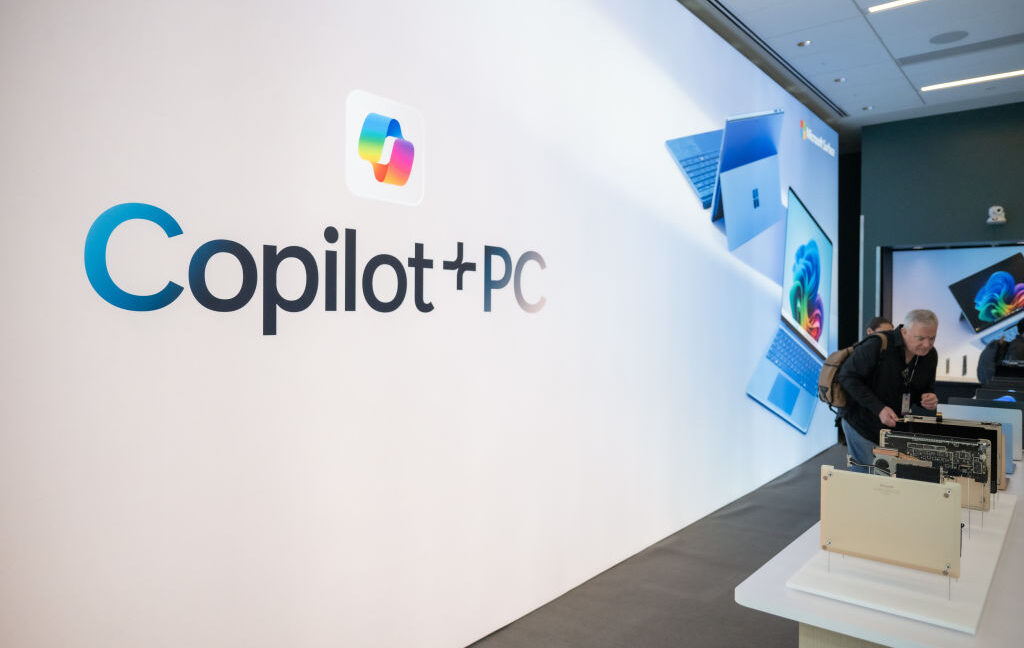
Microsoft's new Surface laptops forgo Copilot+ PC branding.
Google Deepmind researcher Robert O'Callahan has quit, saying AI's "current rate of change is far too high." He worked on chip design tools that helped make AI cheaper and faster, a contribution he can no longer justify. Many colleagues share his concerns but rarely speak out, he says. The article Another Google Deepmind researcher quits, says building superintelligent AI soon is "inherently irresponsible" appeared first on The Decoder .
Mark Zuckerberg has a new defense of the Ray-Ban Meta glasses: They're actually doing more to signal they're taking a photo than phones do. He's brought this up in at least two recent interviews, noting that the glasses have a light that comes on to signal when a photo is being taken, while phones do not. In one of the interviews, Joanna Stern notes that, while phones do not always emit a light, someone does have to hold a phone up in the air, which is itself pretty noticeable. On today's Vergecast , we're talking about Meta Connect, the Muse AI assistant, all the new smart glasses hardware, a
The findings highlight how AI-generated and vibe-coded apps can spill and expose users' data when not configured or secured properly.
Yesterday, with a little prodding, it was discovered that Meta's Muse would expose its filesystem to curious users. The files offered a fascinating peek under the hood of an AI chatbot, and appeared to expose details we weren't meant to see, not least because Muse itself told people, including us, it wasn't supposed to reveal them. But today Muse will eagerly offer up the contents of its file system when you ask for it. That appears to be because, as Meta's Nat Friedman later said, this is the " intended behavior. " In a post on X, Meta Superintelligence Labs' David Singleton elaborated: This
Microsoft is splitting its Copilot app into three sections: Home, Code, and a new agent called "Autopilot." Built on OpenClaw, the agent runs continuously in the cloud, where it can monitor Teams channels and complete tasks on its own, according to Microsoft. For Autopilot and Code, the company is also switching to usage-based billing instead of flat-rate pricing, moving further away from its AI subsidy model. The article Microsoft gives Copilot another makeover, adding an Autopilot agent and usage-based billing appeared first on The Decoder .
Muse is topping the app store charts and adding users at a rapid clip, while Meta ramps up the personal AI agent's promotion across its own apps and beyond.
RAG retrieves. Agents act. I built both separately, connected them explicitly, and ran the same nine tasks through all three systems. The post RAG Isn't an Agent — I Built the Layer Between Retrieval and Action appeared first on Towards Data Science .
Radiology AI is evolving beyond report generation. CARE-X explores a unified approach that combines flexible reasoning, calibrated predictions, and measurement-based tools for chest X-ray interpretation. The post Introducing CARE-X: Towards Clinically Useful Radiology VLMs with Auxiliary Supervision, Reward-Aligned Learning, and Tool-Augmented Measurement appeared first on Microsoft Research .
Reproducing Anthropic's "Toy Models of Superposition" from scratch in NumPy, with hand-derived gradients and no borrowed numbers. The post I Trained a Tiny Network to Compress Data. It Drew a Pentagon. appeared first on Towards Data Science .